Commercial Dataset · Model Years 1999–2027
Electric Vehicle Database
Access electric vehicle data from 1999-2027 by make, model, year, and trim, delivered in JSON format. The database includes battery specifications, charging information, range, powertrain, performance, dimensions, and vehicle features.
Dataset Metrics
Electric Vehicle Data by Year, Make, Model & Trim
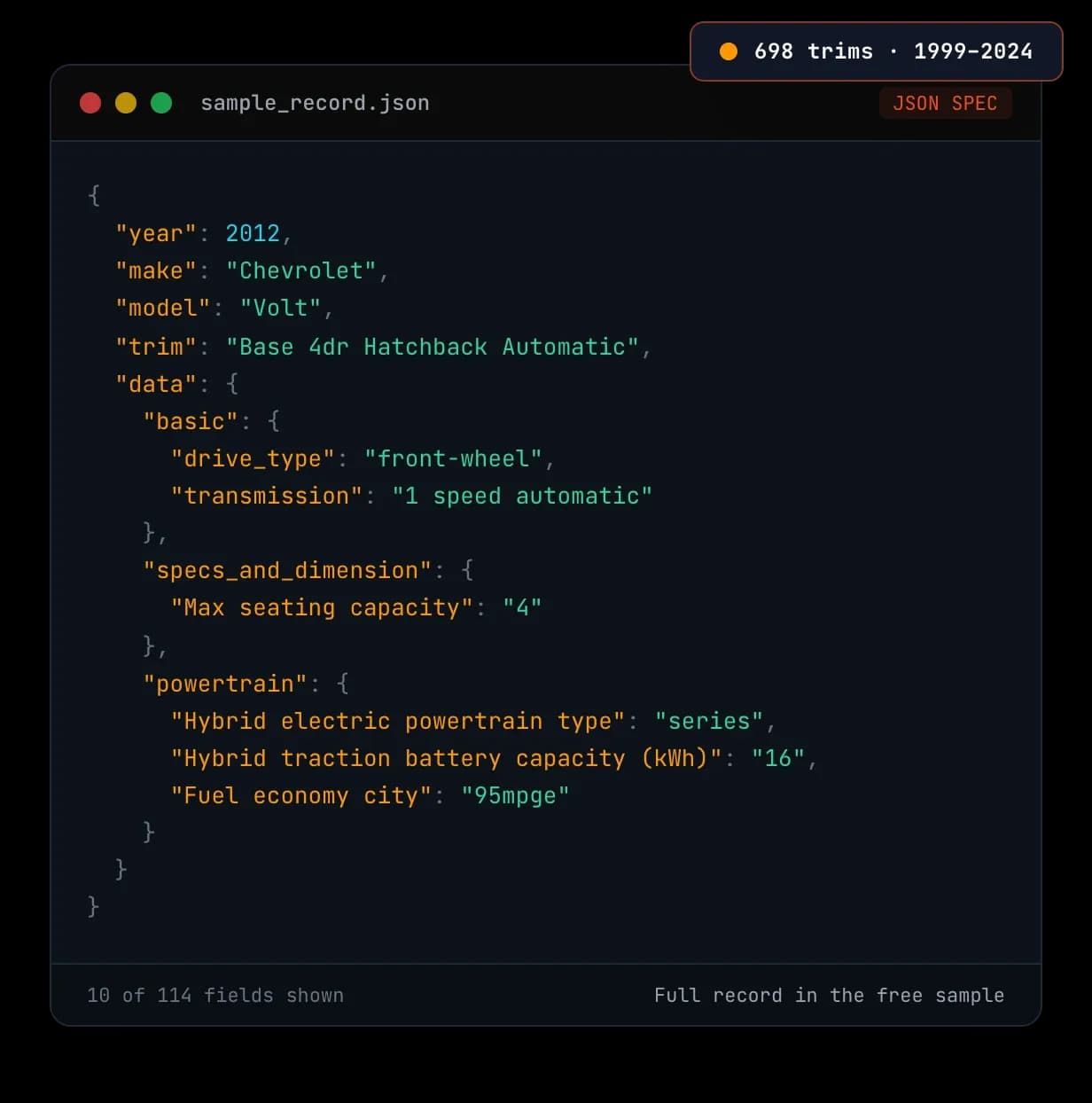
Every record represents a single EV trim, so you get the exact configuration a buyer, fleet or lender is looking at, not a vague model-level summary. Records are organized in a consistent hierarchy (year, make, model, trim) and cover battery electric vehicles, plug-in hybrids and series hybrids sold in the US.
37
Makes
150
Models
888
Trim Level Records
1999–2027
Model Years Covered
USA
Market Coverage
100+
Data Per Trim
JSON
Delivery Formats
Commercial
License
Schema & Categories
What's in the Electric Vehicle Database?
Each trim record is organized into five logical groups, from core identification through powertrain, dimensions, off-road geometry, and feature content.
That makes it easy to pull only what your business or application needs, whether that's a battery size filter or a full spec sheet.
Vehicle Identification
- Model year
- Make
- Model
- Trim (body style, drivetrain and transmission detail)
- Drive type (front, rear, all-wheel)
- Recommended fuel
Powertrain & Motors
- Powertrain type (electric, series hybrid, plug-in hybrid)
- Motor horsepower and torque
- Number of electric motors
- Transmission type
- Differential configuration
- Range extender specifications (for series hybrids)
Battery, Charging & Efficiency
- Traction battery capacity (kWh)
- Battery type and voltage
- Number of battery cells
- Onboard charger output (kW)
- DC fast-charge connector and peak charge rate
- Charge time at 240V
- All-electric range
- MPGe (city, highway, combined)
Dimensions & Capacities
- Exterior length, width, height and wheelbase
- Curb weight and GVWR
- Turning radius
- Headroom, legroom, shoulder room and hip room (by row)
- Cargo volume and passenger volume
- Payload and towing capacity
- Seating capacity and door count
- Tire and wheel sizes
Off-Road & Environmental Ratings
- Approach, departure and ramp breakover angles
- Minimum and maximum ground clearance
- EPA Air Pollution Score
- EPA Greenhouse Gas Score
Features
- Mechanical features
- Exterior features
- Interior features
- Safety features
- Entertainment and connectivity features
Classification
EV Types & Manufacturers in the Database
This database includes all plug-in vehicles sold in the US, including models from the first wave of electric vehicles.
Battery Electric Vehicles (BEVs)
Fully electric vehicles with no combustion engine, from the 1999 Ford Ranger Electric to modern Tesla, Rivian and Lucid models.
Plug-in Hybrids (PHEVs)
Vehicles pairing a rechargeable battery with a gasoline engine, with all-electric range data.
Series Hybrids
Electric-drive vehicles with an onboard generator, such as the Chevrolet Volt.
Trucks, SUVs & Passenger Cars
All body styles, with payload, towing and off-road data for trucks and utility vehicles.
Core Advantages
Why Choose This EV Specifications Database?
How much detail your business gets and how it’s structured are the main reasons to choose this database. It’s structured to provide battery, charging, range and powertrain data for 31 makes and 81 models of plug-in vehicles, all in one dataset.
Trim-Level Precision
Each record includes one specific trim, meaning configurations can be searched, filtered and compared in the same way.
Battery & Charging Depth
Capacity, charger output, connector type and charge times, built for charging and range applications.
25 Years of EV History
Coverage from 1999 to 2024 supports trade-in, residual value, and historical trend analysis, not just current models.
Clear Powertrain Classification
Electric-only powertrains, Series hybrids, and Plug-in hybrids are labelled accordingly. making marketplace filters accurate.
Load It Your Way
CSV for analysts, JSON for web and mobile apps, NoSQL for document databases. All three share the same structure.
Own It, No API Limits
Download once and host it yourself. No rate limits, no latency, no ongoing dependency.
Feature Benchmark
Electric Vehicle Database vs. Free Websites
Free EV websites are fine for looking up a single car, but they weren't built to power businesses and products. Data is scattered across pages, formats change from site to site, and bulk use often violates the terms.
Here's how a purpose-built database compares when you need clean, licensed, trim-level data at scale.
Car DatabasesEV Database | Free Websites & Public Sources | |
|---|---|---|
| Built for | Developers, platforms and businesses | Consumers browsing individual vehicles |
| Access | Full dataset download | Page-by-page lookup, scraping required |
| Structure | Consistent, documented schema | Varies by site, often unstructured |
| Detail level | Trim-level specs, battery, charging, features | Often model-level summaries |
| Coverage | 698 trims, 31 makes, 1999–2024 | Inconsistent, gaps across years and makes |
| Licensing | Royalty-free commercial license | Terms often prohibit commercial or bulk use |
| Updates | 12 months of patch updates included | Unpredictable, no versioning |
Industry Implementations
Common Uses for Electric Vehicle Data
EV data can support much more than a vehicle comparison page. Businesses can use the database as a foundation for products, tools, calculations, and internal workflows.
EV Marketplaces & Dealers
- Range-based and battery-size search filters
- Side-by-side EV comparison tools
- Charging capability and MPGe sorting
Charging Networks & Home Charging
- Charge time calculators
- Connector compatibility lookups
- Charger recommendations based on onboard charger capacity
Fleet Management
- Fleet electrification planning
- Range and charging schedule modeling
- Total cost of ownership comparisons
Insurance & Lending
- EV risk assessment and premium modeling
- Loan-to-value calculations
- Battery and performance based underwriting
Analytics, Research & Sustainability
- EV adoption and battery technology trend analysis
- Range improvement studies over time
- Carbon footprint and emissions savings calculators
Automotive SaaS
- Add EV data to dealer software
- Populate vehicle inventory systems
- Support vehicle comparison tools
- Build EV-focused customer and inventory features
Specifications
Technical & Enterprise Details
Get the data in formats that fit your existing technology stack.
Technical Specifications
- Supported Formats
- CSV, JSON, NoSQL
- Delivery Methods
- Instant Download
- Compliance & Standards
- VCDB Compatible, GDPR Compliant
Enterprise Features
- Secure delivery
- Encrypted, expires-after-use download links
- Version history
- Access to an archive of past database snapshots
- Commercial usage
- Use in apps, websites, SaaS platforms, internal tools, and client deliverables
- Support
- Email support included
Pricing
Pricing That Fits Your EV Data Needs
The Electric Vehicle Database is available through a one-time database purchase.
Complete
$800one-time
Full electric vehicle database for the US market. One purchase, complete coverage — all makes, all trims, all formats.
- 888 EV trims, 37 makes, 150 models
- 1999–2027 USA coverage
- Battery capacity & charging data
- Range & MPGe metrics
- Powertrain classification
- Complete specs & dimensions
- Feature arrays by category
- JSON
- VCDB compatible
- GDPR compliant
- Encrypted secure delivery
- Version control archive access
- Commercial license — royalty-free
- Email support included
Need a custom enterprise license? Contact Sales
Instant Download
Get the Electric Vehicle Database
Bring EV specifications, battery data, range, charging details, and powertrain information into one ready-to-use dataset. Download the database in CSV, JSON, or NoSQL and start working with the data today.
FAQs on the Electric Vehicle Database
What vehicles and years are included?
The electric vehicle database covers US models from 1999 to 2024 including 698 trims, 31 makes, and 81 models. It includes all BEVs, plug-in hybrids and series hybrids from manufacturers, including but not limited to Nissan, Chevrolet, Ford, Toyota, Rivian and Lucid.
Does it include battery capacity and charging data?
Yes, where the data is available for a given trim, the database includes battery capacity in kilowatt-hours (kWh), the output of the on-board charger, the DC fast charger, and peak rate. It includes charge times and other charging-related data.
Coverage is more thorough for recently released vehicles, so review the sample to see if the data is available for the vehicles you are interested in.
What formats does the database come in, and is there an API?
The data is available in CSV, JSON, and NoSQL formats. There is no API. You have to download the files through a secure link and host them yourself. There are no rate limits or ongoing reliance on the data.
Can I use the data in a commercial product?
Yes. You have a royalty-free, commercial license with your purchase to use the data however you want in commercial products, including websites and SaaS products. Contact sales for an enterprise license to allow redistribution or white-labeling.
How often is it updated, and can I see a sample first?
Purchasers receive patch updates for 12 months as new models and data become available, and past versions remain available in the archive. A free sample covering a cross-section of makes, models, and years is available before you buy.