Commercial Dataset · Model Years 1996–2025
OBD-II Diagnostic Trouble Code Database
Access 65,000+ OBD-II diagnostic trouble code records covering standard and manufacturer-specific P, B, C, and U codes from 1996–2025, with definitions, causes, symptoms, and diagnostic information in JSON and SQL formats.
Overview
Access OBD-II Diagnostic Trouble Codes by Code, Type & Manufacturer
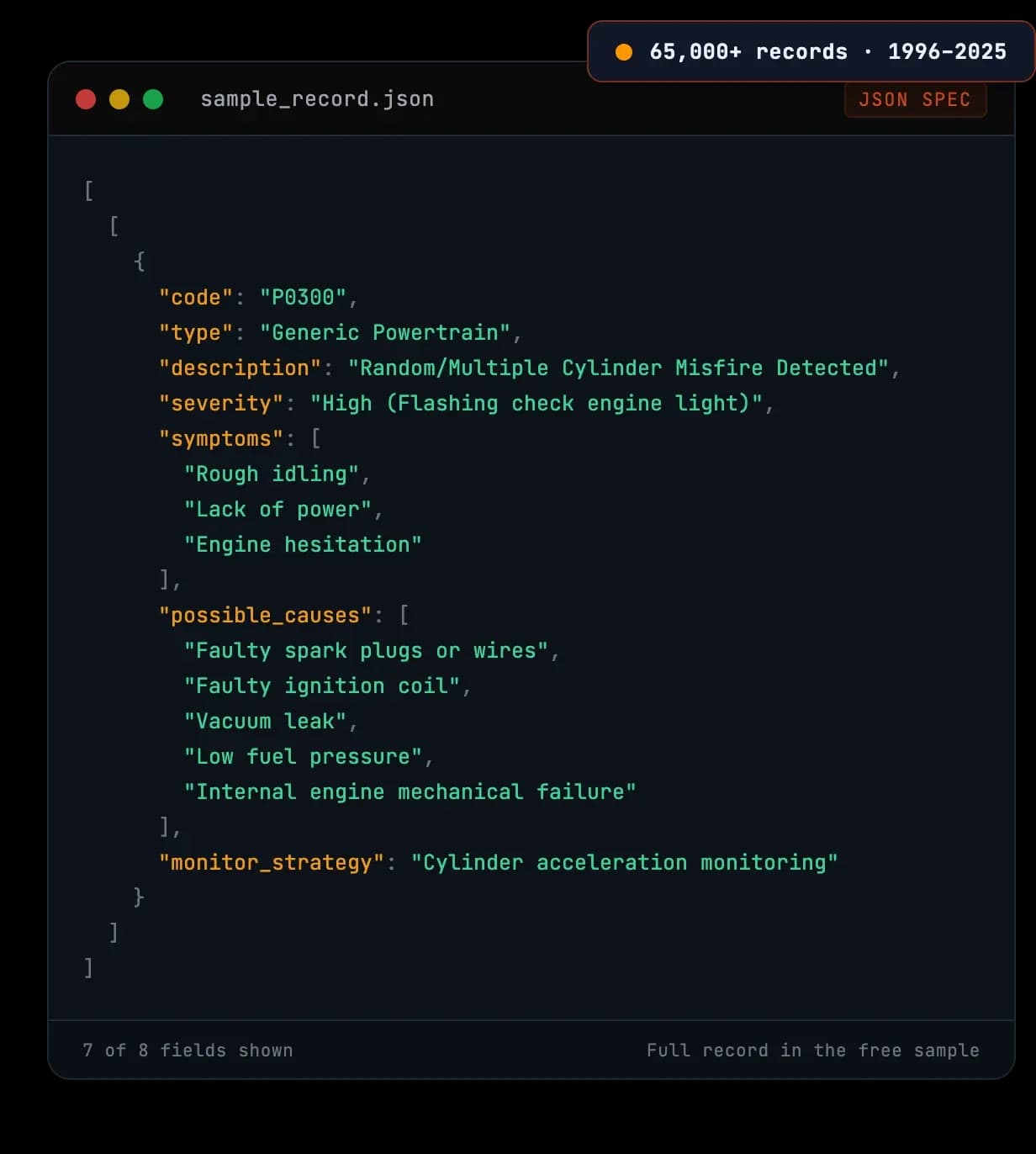
A DTC is just an indication of a problem. Knowing the cause and symptoms are essential in identifying the problem. The DTCs are included in this database along with a description, cause, symptoms, severity, possible monitoring strategies, diagnosis and more.
Dataset Metrics
The DTC Database at a Glance
65,000+
Total Records
55
Makes
150
Models
1996-2025
Model Years Covered
P, B, C, U
Code Families
SAE J2012
Standard
JSON, SQL
Delivery Formats
Commercial
License
Schema & Fields
What's in the DTC Database?
The DTC database goes beyond the code and its short definition to include information that helps explain what the fault represents and what can be checked next.
Code Identification
- DTC code
- Code type
- Generic or manufacturer-specific classification
- Vehicle make where applicable
- Powertrain, body, chassis, or network classification
Definitions & Descriptions
- Standard DTC description
- Technical description
- Layman's definition
- Code classification
- Fault description
Possible Causes
- Possible causes
- Component-related causes
- System-related causes
- Mechanical causes
Symptoms
- Rough idle
- Loss of power
- Engine hesitation
- Check engine light behavior
- Other listed vehicle symptoms
Severity & Monitoring
- Severity
- Monitor strategy
- Fault monitoring information
- Check engine light behavior where available
Diagnostic Steps
- Check for additional codes
- Inspect related components
- Perform applicable tests
- Follow listed diagnostic checks
Classification
DTC Code Families & Types
The database covers the main OBD-II code families and distinguishes between generic and manufacturer-specific codes.
P-Codes: Powertrain
P-codes relate to the engine, transmission, fuel, emissions, and other powertrain systems.
- Generic P0 codes
- Manufacturer-specific P1 codes
B-Codes: Body
B-codes cover vehicle body systems and related components.
- Generic B0 codes
- Manufacturer-specific B1 codes
C-Codes: Chassis
C-codes relate to chassis systems such as braking, steering, suspension, and related vehicle controls.
- Generic C0 codes
- Manufacturer-specific C1 codes
U-Codes: Network
U-codes relate to communication between vehicle control modules and other networked systems.
- Generic U0 codes
- Manufacturer-specific U1 codes
Code Types
Generic vs. Manufacturer-Specific DTCs
Not every diagnostic code means the same thing across every vehicle manufacturer. Generic OBD-II codes follow standardized definitions, while manufacturer-specific codes provide additional brand-level fault information.
Generic Codes
Generic codes follow standardized definitions, and in several cases, OBD-II system definitions, and SAE terminology.
Manufacturer-Specific Codes
Manufacturer-specific codes add brand-specific diagnostic information beyond the generic code set.
Core Advantages
Why Choose This OBD II DTC Database?
Stop scraping unreliable websites. Get the standardized, validated data your business needs to scale.
Full OBD-II Support
All manufacturer and brand (P1, B1, C1, U1) codes, along with standard (P0, B0, C0, U0) codes are included.
Troubleshooting Depth
Get symptoms and possible causes, along with steps to diagnose, in order to give the end user a more comprehensive definition.
Multi-Brand Coverage
Includes brand codes for 55 makes, so fewer lookups return "no definition found."
Severity Built In
Each record includes a severity rating, making alerts and triage in fleet and monitoring tools simple to build.
Standards-Based
Follows SAE J2012 definitions, a consistent foundation for scanners and diagnostic software.
Own It, No API Limits
Download once and host it yourself. No per-lookup fees, rate limits or ongoing dependency.
Feature Benchmark
DTC Database vs. Free Websites
Free DTC lookup sites are fine for decoding one code on one car, but they weren't built to power a product. Here's how a licensed, structured database compares.
Car DatabasesDTC Database | Free Websites & Public Sources | |
|---|---|---|
| Built for | Developers, repair shops, fleets, and platforms | Individual drivers looking up one code |
| Access | Full dataset download | One page at a time, scraping required |
| Structure | Consistent, documented schema | Varies by site, often unstructured |
| Detail level | Severity, symptoms, causes, monitor strategy, diagnosis steps | Often just a code and a short definition |
| Coverage | 65,000 records, 55 makes, 1996-2025 | Inconsistent, many manufacturer codes missing |
| Licensing | Royalty-free commercial license | Terms often prohibit commercial or bulk use |
| Updates | Archive of all past snapshots | Unpredictable, no versioning |
| Cost | One-time purchase | Free, but costly in cleanup and scraping time |
Industry Implementations
Common Uses for DTC Data
DTC information can sit behind diagnostic tools, repair software, fleet systems, and warranty workflows. The useful part is not only identifying the code, but connecting it with the information surrounding that fault.
Independent Repair Shops
- Code lookup for technicians
- Customer report generation
- Repair procedure mapping
Fleet Maintenance Providers
- Real-time fault monitoring
- Severity triage
- Downtime reduction
Extended Warranty Companies
- Pre-existing condition checks
- Claim authorization
- Repair verification
OBD-II Scanner & Diagnostic App Developers
- Translate raw codes into readable explanations
- Offline code lookup inside apps
- Symptom and cause display for drivers
Automotive Insurance & Telematics Providers
- Risk scoring based on recurring fault codes
- Usage-based insurance programs that factor in vehicle health
- Claims review against reported diagnostic faults
Marketplaces & Consumer Apps
- Pre-purchase inspection tools
- "What does this code mean?" lookup features
- Repair cost estimates paired with fault codes
Specifications
Technical & Enterprise Details
The DTC Database is delivered as downloadable data with support for JSON and SQL, secure file delivery, version archives, and commercial usage rights.
Technical Specifications
- Formats
- JSON, SQL
- Delivery method
- Instant download
- Standards
- SAE J2012
- Updated
- Quaterly
Enterprise Features
- Secure delivery
- Each download is secure and provided through an expire-after-use link.
- Version history
- Previous database snapshots are retained for version reference.
- Commercial usage
- Royalty-free use in your applications, websites, and internal tools
Pricing
Pricing for the DTC Database
One purchase, one price, no per-lookup fees.
Complete
Custom pricingquote on request
Full OBD-II diagnostic trouble code library. Pricing is quoted for your use case, license and update needs.
- 65,000+ DTC records
- 55 makes, 150 models
- 1996–2025 model years
- Generic & manufacturer-specific P, B, C, U codes
- Definitions, causes & symptoms per code
- Severity & diagnostic steps
- SAE J2012 standard
- JSON & SQL formats
- Quarterly updates
- Secure expire-after-use delivery
- Version history archive
- Commercial license — royalty-free
Need a custom enterprise license? Contact Sales
Instant Download
Build With 65,000+ DTC Records
Stop piecing together fault codes from scattered websites. Get 65,000 structured OBD-II records with symptoms, causes, and diagnosis steps, and start building today.
FAQs on the DTC Database
What is in the DTC database?
It includes 65,000 diagnostic trouble code records covering all four OBD-II systems: Powertrain (P), Body (B), Chassis (C) and Network (U). Each record has the code, type, description, severity, symptoms, possible causes, monitor strategy and diagnosis steps.
Do records include manufacturer-specific codes?
Yes, this database includes SAE generic codes (P0, B0, C0 and U0) and manufacturer-specific codes (P1, B1, C1 and U1) for Ford, GM, Toyota, Honda, BMW and VW, to name a few.
What formats does it come in, and is there an API?
The DTC data is available in JSON and SQL files. There is no API. You will download the data via a secure link and host it yourself. This also means that your business will not deal with request caps or a fee every time someone looks up a code.
Can I use it in a commercial product?
Yes. A royalty-free commercial license covers use in your apps, websites and internal tools. For redistribution or white-labeling, contact sales about an enterprise license.
What years are covered, and can I see a sample first?
Coverage is from 1996 (when OBD-II was first implemented in the US) to 2025. A sample in JSON format is available to download and preview before purchasing.
Are the diagnostic steps intended to replace factory service information?
Not at all. The diagnostic steps are focused on standardizing code interpretation and providing structural guidance for diagnosing codes. They are also focused on identifying common diagnostic workflows and are not intended to replace manufacturer service information or vehicle-specific repair information.